
How AI is Transforming Digital Marketing in 2026: Hyper-Personalization, Predictive Intelligence, and GEO

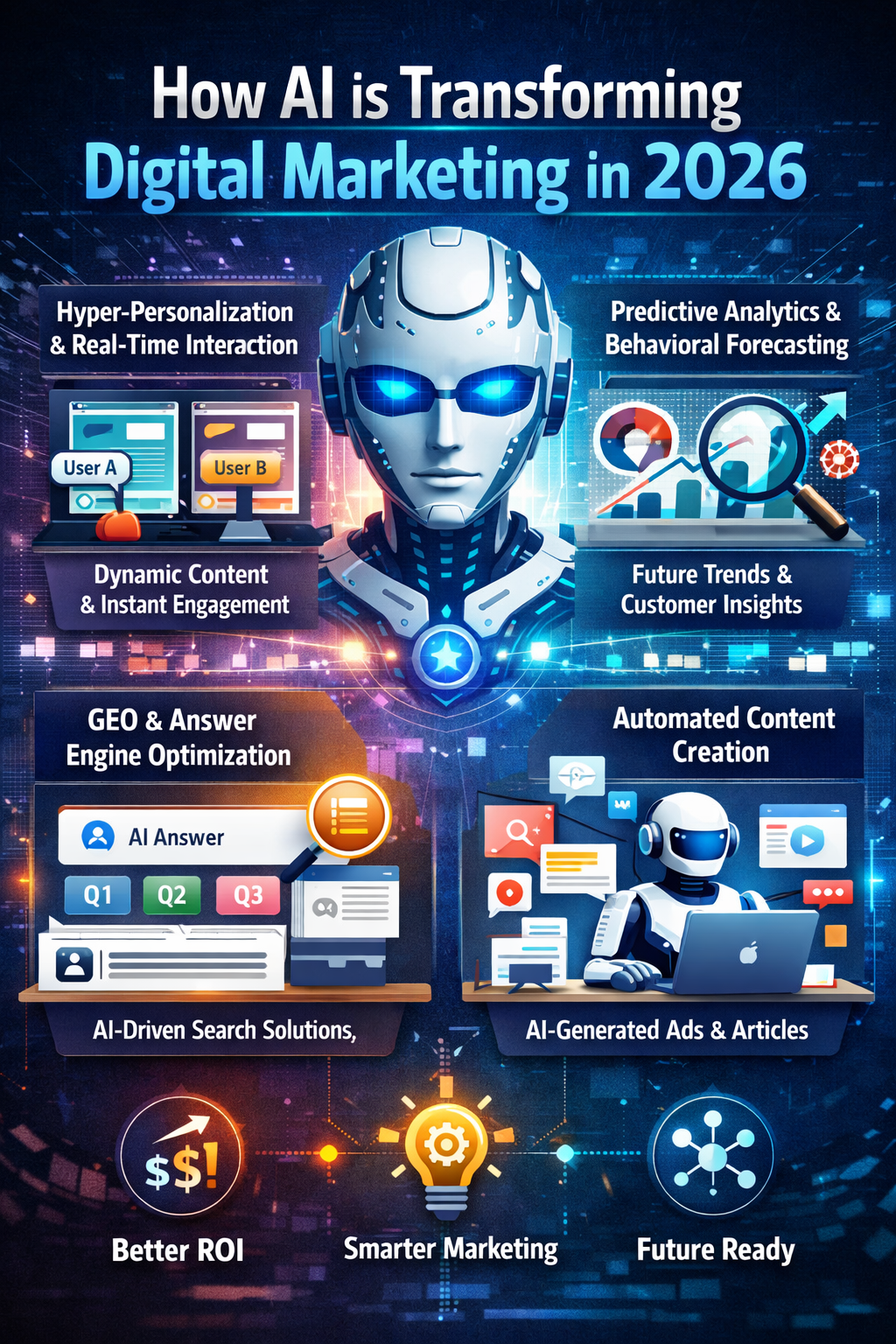
Artificial Intelligence is no longer an experimental tool — it is now the driving engine behind modern Digital Marketing. In 2026, AI is deeply integrated into how brands attract, engage, and convert customers across platforms. From hyper-personalized content and predictive analytics to Generative Engine Optimization (GEO), AI has reshaped marketing strategy, execution, and measurement.
Businesses that adapt to AI-powered Digital Marketing are seeing faster growth, better customer engagement, and higher ROI. Those that don’t are quickly falling behind. Let’s explore the major ways AI is transforming Digital Marketing in 2026 and what it means for marketers and businesses.
Table of Contents
Hyper-Personalization and Real-Time Interaction
One of the biggest changes in Digital Marketing is the shift from basic personalization to hyper-personalization. Earlier, personalization meant inserting a user’s name into an email or recommending products based on past purchases. Today, AI analyzes user behavior in real time and adjusts experiences instantly.
AI systems now track:
-
Browsing patterns
-
Scroll behavior
-
Click timing
-
Purchase signals
-
Content preferences
-
Device and context data
Based on this live data, AI dynamically changes:
-
Website layouts
-
Product recommendations
-
Email content
-
Ad creatives
-
Landing page messages
For example, two users visiting the same website at the same time may see completely different headlines, offers, and visuals — all generated automatically by AI. This real-time adaptation improves relevance and significantly increases conversion rates.
In Digital Marketing campaigns, AI chatbots and AI assistants also provide real-time interaction, answering customer questions instantly and guiding them through buying decisions without human delay.
Predictive Analytics and Behavioral Forecasting
Traditional Digital Marketing relied heavily on historical data — what users did last week or last month. In 2026, AI focuses more on what users are likely to do next.
Predictive analytics powered by machine learning models now forecasts customer behavior with high accuracy. Marketers can identify:
-
Customers likely to churn
-
High-intent buyers
-
Users ready for upsell
-
Leads close to conversion
-
Audiences at risk of disengagement
Instead of reacting after losing a customer, AI alerts marketers before churn happens. Automated workflows then trigger retention campaigns, special offers, or targeted messages.
Predictive Digital Marketing also improves ad spending. AI systems allocate budgets toward audiences most likely to convert — not just those who clicked before, but those predicted to take action soon. This reduces wasted ad spend and improves ROI.
Behavioral forecasting also supports smarter customer journeys. AI maps likely next steps and prepares tailored content in advance, making the entire funnel more efficient.
Generative Engine Optimization (GEO) & Answer Engine Optimization (AEO)
Search behavior has changed dramatically. Users increasingly rely on AI assistants and answer engines instead of traditional search results pages. Because of this, Digital Marketing strategies have evolved from classic SEO to Generative Engine Optimization (GEO) and Answer Engine Optimization (AEO).
In GEO, content is created and structured so AI systems can easily understand, extract, and present it as direct answers. Instead of targeting only broad keywords, marketers now optimize for:
-
Specific questions
-
Conversational queries
-
Problem-solution formats
-
Structured explanations
-
Entity-based content
AI search systems prefer content that is:
-
Clear and well-structured
-
Factually precise
-
Context-rich
-
Directly answerable
-
Logically organized
This means Digital Marketing content must be written not just for humans, but also for AI interpreters. FAQ sections, structured headings, schema markup, and concise answer blocks are now essential.
Brands that optimize for GEO and AEO gain visibility inside AI-generated answers — which is becoming as valuable as ranking #1 in traditional search.
Automated Content Creation at Scale
Content remains central to Digital Marketing, but how content is produced has changed. Generative AI tools now handle bulk content creation across formats:
-
Blog drafts
-
Product descriptions
-
Ad copy
-
Email sequences
-
Social posts
-
Video scripts
-
Landing page variants
Marketers no longer start from a blank page. AI generates first drafts instantly, allowing teams to focus on strategy, editing, and brand voice refinement.
This has made it possible to produce personalized content at scale. For example, one campaign can automatically generate hundreds of ad variations tailored to different audience segments.
However, successful Digital Marketing teams don’t rely on AI alone — they combine AI speed with human creativity and brand oversight to maintain quality and authenticity.
Real-Time Creative Optimization
AI is also transforming how ads and creatives are optimized. Instead of running one version of an ad for weeks, AI systems now adjust creative elements in real time based on performance data.
Machine learning continuously tests:
-
Headlines
-
Images
-
Video thumbnails
-
CTA buttons
-
Copy length
-
Color combinations
Underperforming variations are automatically paused, while high-engagement versions receive more budget. This process happens continuously without manual intervention.
In Digital Marketing campaigns, this leads to:
-
Faster performance improvements
-
Lower acquisition costs
-
Higher engagement rates
-
Better creative decisions
Creative optimization is no longer periodic — it is continuous and AI-driven.
AI-Driven Customer Journey Orchestration
Another major shift in Digital Marketing is AI-managed customer journey orchestration. AI platforms now coordinate messaging across multiple channels:
-
Email
-
Social media
-
Paid ads
-
SMS
-
Push notifications
-
Website content
AI decides the best time, channel, and message for each user. If a user ignores an email but clicks a social ad, the system adapts the next message accordingly.
This creates a seamless, cross-channel experience instead of disconnected campaigns. Marketers define goals and guardrails, while AI handles timing and delivery.
Smarter Marketing Measurement and Attribution
Attribution has always been a challenge in Digital Marketing. AI now improves attribution modeling by analyzing complex multi-touch journeys across devices and platforms.
AI attribution models can:
-
Identify hidden conversion paths
-
Assign weighted credit accurately
-
Detect influence beyond last click
-
Reveal high-impact channels
This gives marketers clearer insight into what truly drives results — leading to smarter budget allocation.
The Future of Digital Marketing Is AI-Augmented
In 2026, Digital Marketing is not replaced by AI — it is augmented by AI. Human marketers remain essential for:
-
Strategy
-
Brand storytelling
-
Emotional intelligence
-
Ethical judgment
-
Creative direction
AI handles speed, scale, and predictive intelligence. The most successful marketers combine both.
Businesses that embrace AI-powered Digital Marketing — including hyper-personalization, predictive analytics, GEO, and automated optimization — are building stronger customer relationships and achieving better performance than ever before.

Chinnu Sunny
Chinnu Sunny is an Wordpress Web Designer at Upgraderz