
AI-Powered Website Builders: Are Developers at Risk

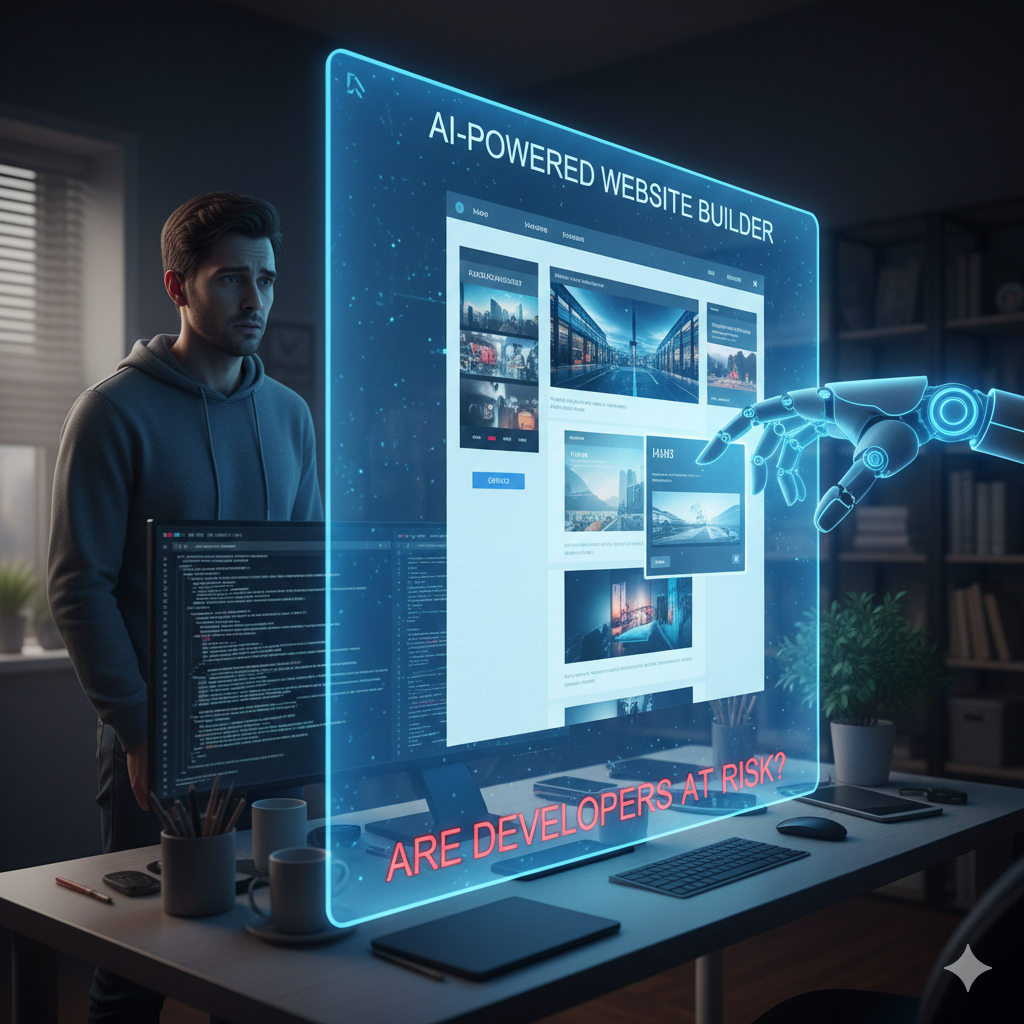
Artificial Intelligence is reshaping how websites are designed, built, and launched. AI-powered website builders can now generate layouts, write content, select color palettes, and even optimize pages for SEO within minutes. What once required days of planning and coding can now be done through a few prompts and clicks. This rapid change has created an important question in the tech community: are Developers at risk, or are these tools simply changing how web creation works?
The answer is more balanced than many fear. AI website builders are powerful, but their impact depends on the type of project, the level of customization needed, and the business goals behind the website.
AI-powered builders are improving fast, but the real question businesses ask is whether Developers will be replaced or whether their roles will evolve with these new tools.
Table of Contents
The Rise of AI Website Builders
AI website builders are platforms that use machine learning and automation to create websites with minimal human effort. Users answer a few questions about their business, preferences, and goals, and the system generates a ready-made site structure. Some tools even produce images, marketing copy, and layout suggestions automatically.
For small businesses and individuals, this is a major advantage. Instead of hiring a full web team, they can launch a basic website quickly and at a low cost. Speed and convenience are the biggest selling points. This has especially changed the entry-level website market — simple portfolios, landing pages, and brochure-style business sites.
For quick launches, these tools are useful, but many businesses still consult Developers to review structure, performance, and future scalability.
Because of this, the demand for very basic site creation is shifting away from manual build processes toward automated platforms.
Where AI Builders Perform Best
AI-powered builders are particularly effective in predictable, repeatable scenarios. For example, a small restaurant website, a personal blog, or a simple service landing page often follows standard design patterns. AI can easily assemble these structures using tested templates and best practices.
These platforms also help users who have no coding knowledge. Drag-and-drop editing combined with AI suggestions reduces the technical barrier. Tasks like spacing, typography pairing, and responsive layout adjustments are handled automatically.
These platforms reduce effort for small projects, but experienced Developers still provide better structure, scalability, and long-term flexibility when business needs grow
For startups with tight budgets, this is a practical solution. They get online presence without heavy upfront investment. In this specific segment, automation is replacing a portion of traditional manual work.
The Limits of Automation
When evaluating how automation is changing web creation, it helps to look at industry standards and research. Technical guidance from platforms like Google Search Central, the Mozilla Developer Network, and the World Wide Web Consortium (W3C) shows that while AI tools can quickly generate layouts and basic optimizations, advanced performance tuning, accessibility compliance, and structured architecture still depend on human expertise. Industry research firms such as Gartner also note that AI works best as an assistive layer in digital production rather than a total replacement for expert-led implementation, especially in complex, secure, and custom-built web projects.
Automated systems cannot fully match how Developers handle edge cases, security layers, and complex logic requirements in real-world projects.
Changing Roles Instead of Job Loss
Rather than eliminating technical roles, AI is reshaping them. The nature of web work is moving from repetitive building toward strategic and specialized implementation. Professionals who once spent hours creating standard layouts can now focus on performance tuning, user experience design, accessibility, and system architecture.
This shift is similar to what happened when content management systems first appeared. They did not eliminate technical careers — they changed the skill requirements. The same pattern is repeating with AI tools.
Those who adapt by learning AI-assisted workflows, prompt-based design control, and automation supervision will likely become more productive, not obsolete.
Custom Projects Still Need Human Expertise
Large organizations rarely need generic websites. They require tailored platforms built around their processes and customer journeys. E-commerce systems, learning platforms, SaaS dashboards, booking engines, and enterprise portals involve layers of logic and integration.
Such systems demand planning, testing, iteration, and ongoing optimization. Automated builders cannot independently design complex user flows or resolve edge-case failures. Human-led architecture and testing remain critical.
Performance optimization is another area where expertise matters. Page speed, server configuration, caching strategies, and database efficiency are not reliably handled by one-click builders. These factors directly affect search rankings and user retention.
Large-scale platforms continue to rely on skilled Developers for architecture planning, integrations, and testing.
Creativity and Brand Identity
AI can assemble visually pleasing designs, but true brand identity requires creative direction. Visual storytelling, emotional tone, and user journey mapping are not purely technical tasks. They involve interpretation and originality.
Automated systems tend to reuse patterns learned from existing data. That means many AI-generated sites can look similar. Businesses that want to stand out still benefit from custom creative input and design thinking.
Creative direction and user journey design are areas where Developers and designers work together beyond what automated builders can generate.
Originality, narrative flow, and audience targeting remain human strengths. Tools can assist — but not replace — creative strategy.
Collaboration Between AI and Technical Professionals
The most realistic future is collaboration. AI becomes a productivity partner rather than a competitor. It speeds up prototyping, generates first drafts, suggests layouts, and automates repetitive tasks. Meanwhile, technical experts refine, customize, secure, and scale the solution.
This hybrid workflow reduces project time while increasing quality. Instead of building everything from scratch, professionals can start from AI-generated foundations and improve them.
Those who learn to guide AI output — through structured prompts, design constraints, and validation processes — will have a competitive advantage.
Skills That Will Stay Valuable
As automation grows, certain skills become even more important:
-
System architecture planning
-
Advanced UI/UX strategy
-
Performance engineering
-
Security hardening
-
API and service integration
-
Accessibility compliance
-
Conversion optimization
-
Complex problem solving
These are not easily automated because they depend on context, trade-offs, and business understanding.
Continuous learning will be key. The web field has always evolved, and adaptability has always been the strongest career protection.
AI-powered website builders do pose a significant threat to low-end, simple site creation. That part of the market is becoming faster, cheaper, and more automated. However, they are better understood as empowering tools rather than total replacements for skilled professionals.
Complex, secure, and bespoke projects still require human expertise, judgment, and creativity. The workflow is changing — not disappearing. Those who embrace AI as a tool, upgrade their skills, and move toward higher-value work will remain essential in the web ecosystem.
The future will likely belong to Developers who learn to work alongside AI tools rather than compete against them.

Chinnu Sunny
Chinnu Sunny is an Wordpress Web Designer at Upgraderz