
Human Skills Are Back: Why Empathy, Judgment, and Creativity Are the Top Skills of 2026

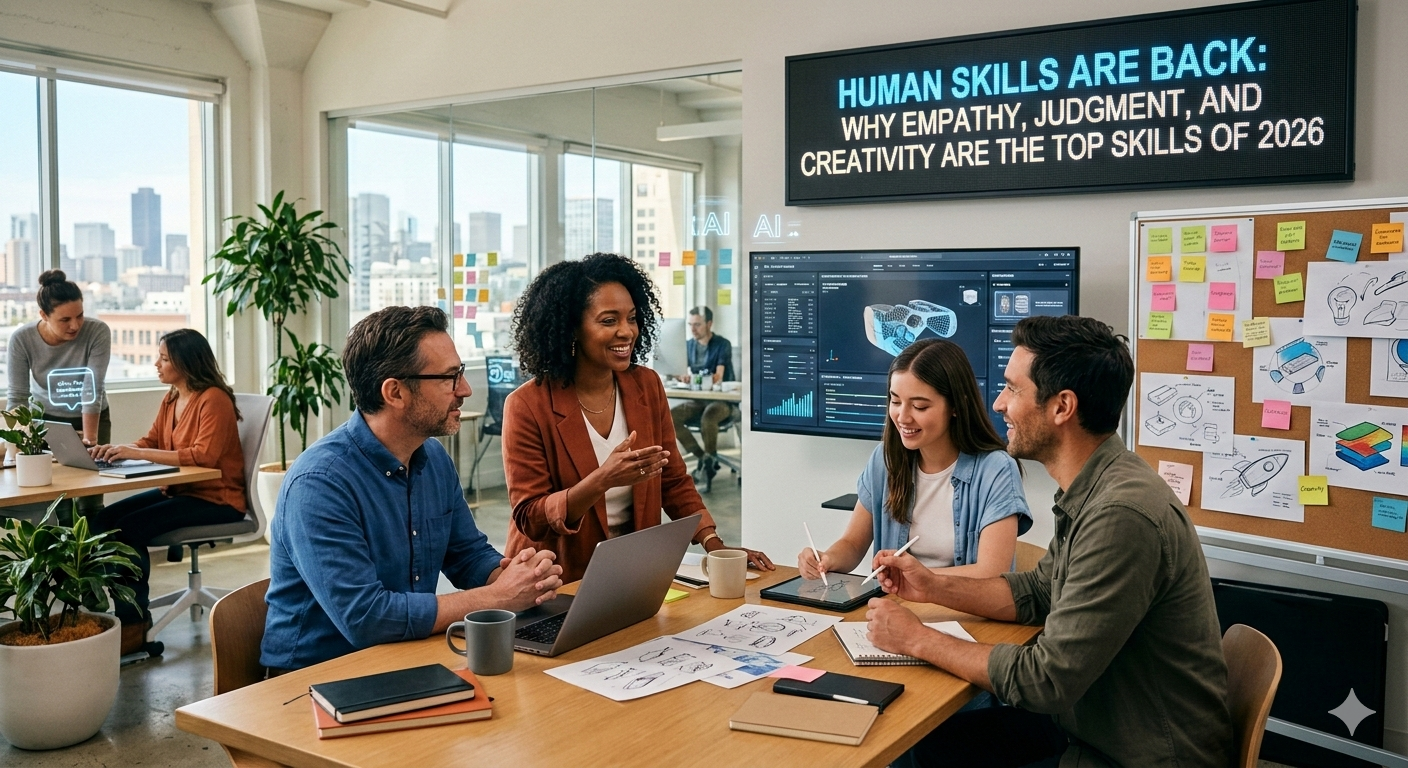
In recent years, technology has transformed the way we work. Artificial intelligence, automation, and digital tools are reshaping industries across the world. While technical expertise remains valuable, something unexpected is happening in the modern workplace: Human Skills are becoming more important than ever.
In 2026, employers are realizing that machines can process data, generate code, and automate repetitive tasks. However, they cannot replace empathy, creativity, or ethical judgment. These uniquely Human Skills are now the most valuable capabilities professionals can develop to stay relevant and succeed in the future workforce.
Table of Contents
Why Human Skills Matter More in the AI Era
The rapid growth of artificial intelligence has shifted the focus from purely technical knowledge to interpersonal and cognitive abilities. AI systems are excellent at analyzing large datasets and performing routine tasks, but they struggle with understanding emotions, making ethical decisions, or navigating complex human relationships.
Experts increasingly agree that professionals who combine technical knowledge with Human Skills will have a significant advantage. A global workforce survey found that most employees believe uniquely human abilities such as empathy and creativity will become even more important as AI adoption increases.
This shift shows that the future of work is not about humans competing with technology. Instead, it is about humans working alongside technology while using their Human Skills to solve problems that machines cannot.
Empathy: The Power of Understanding People
Empathy is one of the most valuable Human Skills in modern workplaces. It refers to the ability to understand and share the feelings of others. In professional environments, empathy helps leaders build trust, resolve conflicts, and create supportive teams.
Technology cannot truly understand human emotions or social dynamics. While AI can analyze patterns in communication, it cannot genuinely feel compassion or respond emotionally in complex situations.
Research from Harvard Business Review explains that leaders who develop empathy and emotional intelligence build stronger teams and more productive workplaces
In customer service, healthcare, education, and management roles, empathy-driven Human Skills are becoming a major differentiator between average and exceptional professionals.
Judgment: Making Decisions in Uncertain Situations
Another critical ability in the modern workplace is judgment. AI systems can provide recommendations based on data, but they cannot fully understand context, ethics, or long-term consequences.
Human judgment involves analyzing complex situations, considering multiple perspectives, and making responsible decisions. These Human Skills become especially important when leaders face difficult choices that involve ethics, culture, or social impact.
For example, companies using AI must still rely on humans to evaluate fairness, prevent bias, and ensure responsible technology use. Organizations increasingly depend on professionals who can combine data insights with thoughtful judgment.
In industries such as law, healthcare, finance, and management, these decision-making Human Skills remain essential because many real-world problems do not have simple or predictable answers.
Creativity: The Engine of Innovation
Creativity is another ability that technology struggles to replicate fully. AI can generate content or remix existing ideas, but it often lacks the original thinking that drives innovation.
Human creativity allows professionals to imagine new products, design unique marketing strategies, and solve problems in unexpected ways. Businesses rely on these Human Skills to remain competitive in rapidly changing markets.
In design, media, entrepreneurship, and product development, creativity enables people to transform ideas into real value. When companies combine AI tools with human creativity, they unlock powerful new possibilities.
This is why organizations increasingly seek employees who can think differently, challenge assumptions, and bring original ideas to the table.
Collaboration and Communication
Another reason Human Skills are rising in importance is the growing need for collaboration. Modern teams often work remotely, across cultures, and across disciplines.
Clear communication, teamwork, and relationship building are crucial for successful collaboration. These abilities help professionals share ideas effectively and coordinate complex projects.
Strong communication Human Skills also improve leadership, negotiation, and conflict resolution. While technology can assist communication, it cannot replace the nuance and emotional intelligence required for effective teamwork.
Companies now recognize that high-performing teams depend not only on technical talent but also on individuals who can connect with others and work toward shared goals.
The Future of Work: Humans and AI Together
The rise of AI does not mean humans are becoming less important. In fact, the opposite is happening. As machines handle routine work, people are free to focus on higher-level thinking and meaningful interactions.
According to global workforce research, organizations are increasingly investing in training programs to improve Human Skills such as communication, leadership, and creativity.
Reports on future workforce trends emphasize that analytical thinking, creativity, resilience, and emotional intelligence will dominate the list of essential skills in coming years.
In other words, technology is not replacing people—it is redefining what makes humans valuable.
Professionals who develop strong Human Skills will be able to adapt, lead teams, and innovate in ways that machines cannot replicate.
How to Develop Human Skills
Building strong Human Skills requires continuous learning and practice. Here are some ways professionals can strengthen these abilities:
Practice active listening to understand others better.
Develop emotional intelligence through self-awareness and empathy.
Engage in creative activities such as brainstorming, design thinking, or storytelling.
Seek diverse perspectives to improve judgment and decision-making.
Collaborate with others on projects that require teamwork.
These learning opportunities help professionals strengthen the Human Skills that will define career success in the coming decade.
The future workplace is changing rapidly, but one thing is becoming clear: the most valuable abilities are not technical tools alone—they are deeply human qualities.
Empathy helps us understand people. Judgment helps us make responsible decisions. Creativity allows us to innovate and build new possibilities.
As automation continues to transform industries, professionals who invest in developing Human Skills will stand out as leaders, innovators, and problem-solvers.
In 2026 and beyond, the real competitive advantage will not be how much technology you know, but how effectively you use your Human Skills to create meaningful impact
