
The Agentic Buyer Journey: How AI Agents Are Redefining Commerce in 2026

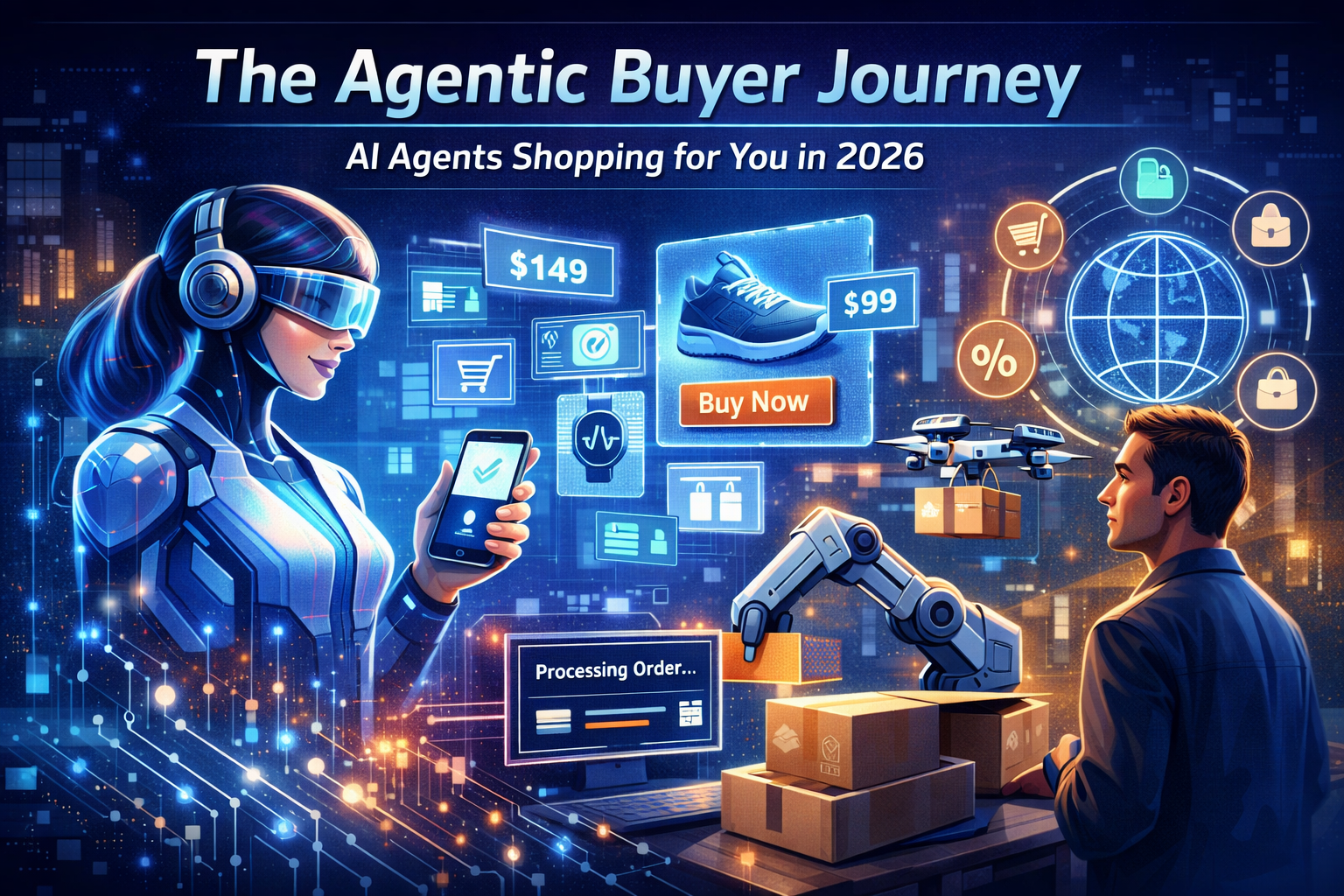
The digital shopping experience is undergoing a major transformation. Search engines, comparison sites, and manual browsing are no longer the only paths to purchase. In 2026, we are entering the era of the Agentic Buyer Journey — where AI agents don’t just recommend products but actively evaluate, decide, and execute purchases on behalf of users. This shift is powered by Agentic AI and emerging Agentic Commerce Protocols that allow machines to interact directly with retailer systems.
For brands and retailers, this is not just a technology trend — it is a structural change in how discovery, trust, and transactions happen online.
Table of Contents
What Is the Agentic Buyer Journey?
The Agentic Buyer Journey is a purchasing process where autonomous or semi-autonomous AI agents act on behalf of consumers. Instead of a shopper manually searching, comparing, and checking out, an AI assistant can:
-
Understand user intent and constraints
-
Compare products across multiple retailers
-
Evaluate price, delivery time, and reviews
-
Negotiate or select best-fit options
-
Complete the purchase automatically
This means the “buyer” interacting with your product pages may no longer be a human — it may be a machine acting for one.
Traditional buyer journeys were built around awareness → consideration → decision. The agentic model compresses these stages into machine-speed evaluation and action.
From Recommendation to Execution
Earlier AI shopping tools focused on recommendations — “You may also like” or “Best products for you.” Agentic systems go further. They are execution-capable.
Modern AI agents can:
-
Read structured product data
-
Interpret policies and guarantees
-
Validate availability
-
Trigger checkout flows
-
Place orders through supported protocols
This is made possible by Agentic Commerce Protocols and standards such as machine-readable product feeds, structured schema markup, and universal purchase APIs. These frameworks allow AI systems to transact safely and consistently across platforms.
For retailers, this means product pages must now speak two languages: one for humans and one for machines.
Why Machine-Readable Commerce Matters
In the Agentic Buyer Journey, visibility alone is not enough. Your product information must be machine-readable and machine-actionable.
This requires:
Structured Schema Markup
Retailers must implement detailed schema markup for:
-
Product details
-
Pricing
-
Availability
-
Shipping terms
-
Return policies
-
Reviews and ratings
AI agents rely on structured data to make decisions quickly. Pages without clean schema may be skipped entirely.
Universal Commerce Protocol Support
Universal Commerce Protocols (UCP-style frameworks) allow:
-
Standardized product queries
-
Secure agent-based checkout
-
Verified merchant identity
-
Automated transaction handling
Without protocol compatibility, AI agents may not be able to complete purchases even if they find your product.
In short: if machines cannot read and transact with your store, you risk losing machine-driven buyers.
Disintermediation Risk: Third-Party Agents
One of the biggest disruptions in the Agentic Buyer Journey is the rise of third-party shopping agents. These independent AI systems represent consumers and choose where to buy — often without brand loyalty.
This creates a real risk of retailer disintermediation, where:
-
The agent controls product selection
-
The agent controls merchant choice
-
The retailer becomes a fulfillment endpoint only
In this model, branding, storytelling, and website UX matter less than:
-
Structured data quality
-
Price competitiveness
-
Fulfillment reliability
-
Machine trust signals
However, research and early market behavior show something important: consumers trust retail-owned agents about three times more than third-party agents.
That creates a major opportunity.
Retail-Owned AI Agents as a Trust Advantage
Leading retailers are responding by building on-site AI shopping agents that live within their own digital platforms. These agents help shoppers:
-
Navigate complex product catalogs
-
Compare variations and bundles
-
Understand compatibility
-
Optimize carts
-
Complete purchases faster
Because these agents are owned by the retailer, they benefit from:
-
Direct product knowledge
-
Real-time inventory data
-
Native policy interpretation
-
Stronger brand trust
Retail-owned agents also protect margin and customer relationships by reducing dependence on third-party intermediaries.
The winning strategy is not either/or — it is both.
Partnering With Third-Party Agents
Even with strong on-site AI agents, retailers must still be discoverable where shoppers initiate their journeys. That increasingly includes third-party AI assistants embedded in:
-
Operating systems
-
Browsers
-
Messaging platforms
-
Voice assistants
-
Enterprise tools
Retailers should partner with these ecosystems by providing:
-
Agent-accessible product feeds
-
Verified merchant endpoints
-
Protocol-based purchase options
-
Transparent pricing data
-
Real-time availability APIs
The Agentic Buyer Journey is omnichannel — but now the channels include machines.
AI Referral Traffic Is Small — But Growing Fast
Some retailers already report that AI systems generate up to 25% of their referral traffic. However, this still represents less than 1% of total traffic overall.
This gap signals two things:
Adoption is early but accelerating
Optimization now creates first-mover advantage
Just as SEO pioneers gained outsized benefits in early search, Agentic Commerce Optimization will reward early adopters.
Retailers who prepare machine-readable infrastructure now will be preferred by AI agents as usage scales.
How to Optimize for the Agentic Buyer Journey
To prepare for agent-driven commerce, retailers should act in five key areas:
Upgrade Structured Data
Implement comprehensive schema for products, offers, policies, and fulfillment.
Enable Machine Purchase Paths
Support standardized APIs and protocol-based checkout flows.
Build a Retail-Owned AI Assistant
Deploy an on-site agent that helps users and builds trust.
Publish Clean Commerce Feeds
Ensure product data is consistent, validated, and frequently updated.
Design for Intent, Not Just Clicks
Optimize content around purchase intent and decision clarity — not just rankings.
The Future Is Agent-Mediated Commerce
The Agentic Buyer Journey marks a shift from search-driven shopping to agent-mediated commerce. Decisions will increasingly be made by AI systems acting in the consumer’s best interest — based on data quality, trust signals, and transaction readiness.
Retailers who adapt will gain machine visibility, machine trust, and machine transactions. Those who do not risk becoming invisible to the very agents that will soon control a large share of purchasing decisions.

Chinnu Sunny
Chinnu Sunny is an Wordpress Web Designer at Upgraderz