
Slow Website Impact on Sales: Hidden Costs & Solutions

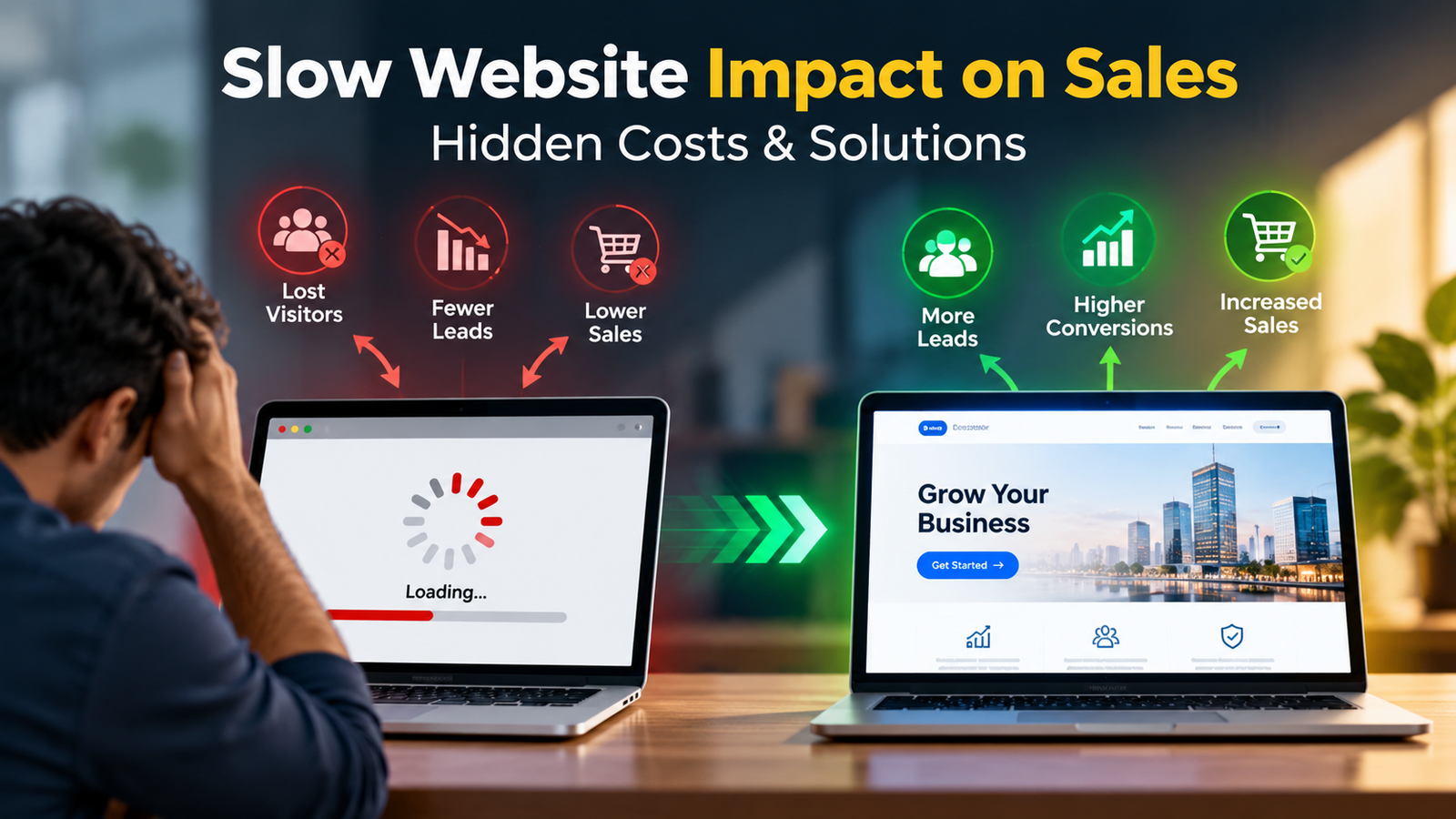
Your website is often the first interaction customers have with your business. But what happens when your website takes too long to load? Visitors lose patience, abandon the page, and move to competitors.
The slow website impact on sales is more significant than many business owners realize. A few seconds of delay can affect customer engagement, lead generation, conversion rates, and overall business revenue.
Whether you operate an e-commerce store, a service-based company, or a local business in Kochi, website loading speed plays an important role in online success.
Understanding how website performance influences customer behavior is the first step toward improving your digital marketing results.
Table of Contents
Why Website Speed Matters for Business Growth
Website speed refers to how quickly a website loads and becomes usable for visitors.
Modern internet users expect websites to deliver information quickly. When pages take too long to load, visitors may leave before exploring products or services.
A fast-loading website helps businesses achieve several important goals:
-
Improve user experience and customer satisfaction.
-
Reduce bounce rates and unnecessary page abandonment.
-
Increase enquiries, form submissions, and purchases.
-
Support search engine optimization (SEO).
-
Build credibility and trust among potential customers.
The slow website impact on sales becomes particularly noticeable when businesses depend heavily on website enquiries or online transactions.
How Slow Websites Affect Leads and Conversions
Imagine a potential customer searching Google for digital marketing services in Kochi. They discover your website and click the link.
However, the website takes several seconds to display important information. Instead of waiting, the visitor returns to Google and chooses another agency.
Your business has just lost a potential lead.
This situation highlights the slow website impact on sales and demonstrates how poor website performance can negatively affect lead generation, customer engagement, and business conversions.
Higher Bounce Rates
Slow-loading pages can encourage visitors to leave without interacting with your content.
Lower Conversion Rates
Visitors who experience delays may be less likely to complete enquiry forms, request quotations, or make purchases.
Reduced Customer Trust
A poorly performing website can create an impression of outdated technology or unreliable service.
Lost Revenue Opportunities
When fewer visitors complete desired actions, businesses may experience reduced sales and lower returns from marketing campaigns.
Understanding the slow website impact on sales helps businesses identify why traffic does not always translate into enquiries.
The Relationship Between Page Speed and SEO
Google uses page experience signals, including Core Web Vitals, within its ranking systems.
Although website speed alone does not determine search rankings, poor technical performance can weaken the overall user experience.
Google’s Core Web Vitals measure important aspects of website usability.
| Metric | What It Measures | Good Threshold |
|---|---|---|
| Largest Contentful Paint (LCP) | Main content loading performance | 2.5 seconds or less |
| Interaction to Next Paint (INP) | Responsiveness to user interactions | 200 milliseconds or less |
| Cumulative Layout Shift (CLS) | Visual stability | 0.1 or less |
These thresholds are evaluated at the 75th percentile of real-user experiences.
Businesses should regularly monitor these metrics to identify website performance problems.
You can evaluate your website using Google PageSpeed Insights.
A technically optimized website supports SEO efforts while creating a smoother experience for visitors.
Hidden Costs of a Slow Website
Many businesses focus on website design and content while overlooking performance.
However, the slow website impact on sales extends beyond lost website visitors.
Wasted Advertising Budget
Businesses running Google Ads or Meta Ads spend money attracting potential customers.
If users click an advertisement but abandon the landing page because it loads slowly, the business may lose valuable advertising opportunities.
Lower Lead Generation
Slow enquiry forms, delayed buttons, and unresponsive landing pages can discourage customers from contacting a business.
Reduced Mobile Engagement
Many customers browse websites using smartphones. Large images, unnecessary scripts, and inefficient website design can create particularly frustrating experiences on mobile networks.
Increased Customer Acquisition Costs
When website conversion rates decline, businesses may need additional advertising traffic to generate the same number of leads.
This makes website performance an important consideration for marketing profitability.
How Website Speed Influences Customer Buying Decisions
Website performance affects different stages of the customer journey. Understanding the slow website impact on sales is essential for businesses aiming to improve customer experience and conversions.
A customer visiting an online store expects product pages, images, and checkout processes to work smoothly.
Similarly, someone searching for construction companies, healthcare services, or digital marketing agencies expects quick access to service information and contact details.
Consider a hypothetical business receiving 5,000 monthly visitors.
| Performance Scenario | Conversion Rate | Monthly Leads |
|---|---|---|
| Before optimization | 2% | 100 |
| After optimization | 3% | 150 |
In this illustration, improving the conversion rate from 2% to 3% generates 50 additional leads without increasing website traffic.
These figures are illustrative, not a guaranteed outcome of speed optimization.
The example highlights how improving website performance can potentially support business growth.
Common Reasons Websites Load Slowly
Before improving performance, businesses must identify the underlying problems.
Common causes include:
- Unoptimized Images: Large image files increase page weight and loading time.
- Poor Web Hosting: Inadequate server resources can slow website responses.
- Excessive Plugins: Unnecessary WordPress plugins may introduce additional scripts and processing overhead.
- Heavy JavaScript and CSS: Large or inefficient code files can delay page rendering and responsiveness.
- Lack of Caching: Without effective caching, browsers and servers may repeat unnecessary work.
- Third-Party Scripts: Advertising trackers, chat widgets, and external integrations can increase loading time.
Identifying these issues is essential for reducing the slow website impact on sales.
Practical Ways to Improve Website Loading Speed
Website speed optimization does not always require rebuilding an entire website.
Several technical improvements can make a meaningful difference.
Optimize Images
Convert suitable images into modern formats such as WebP or AVIF, resize them appropriately, and use lazy loading for below-the-fold images.
Enable Browser and Server Caching
Caching reduces repeated requests and can improve loading performance for returning visitors.
Use a Content Delivery Network (CDN)
A CDN delivers website resources from servers closer to visitors, potentially reducing network latency.
Remove Unnecessary Plugins
Review WordPress plugins regularly and remove those that are outdated, unused, or unnecessarily resource-intensive.
Minimize JavaScript and CSS
Reduce unused code, defer non-critical scripts, and prioritize resources needed for the initial page display.
Choose Reliable Hosting
Select hosting that provides adequate performance, security, and scalability for your website traffic.
For technical guidance, refer to Google’s Web Performance Learning Resources.
Why Website Speed Matters for Businesses in Kochi
Businesses in Kochi and across Kerala increasingly depend on digital channels to attract customers.
Whether someone searches for a construction company in Ernakulam, a restaurant in Kakkanad, or professional services in Kochi, website experience can influence which business receives the enquiry.
A slow website can reduce the effectiveness of local SEO, paid advertising, and social media campaigns by creating friction after a potential customer clicks through.
Local businesses should prioritize mobile-friendly design, clear navigation, accessible contact information, and fast-loading service pages.
Improving website performance can help convert more of the traffic generated through digital marketing.
How Upgraderz Helps Businesses Improve Website Performance
At Upgraderz Digital Solutions Pvt. Ltd., we understand the slow website impact on sales and believe that a business website should do more than look attractive. It should load quickly, help visitors discover services, engage with the brand, and take meaningful action that drives leads and conversions.
Our website development, SEO, and digital marketing services focus on building a stronger online presence for businesses.
Through website performance analysis, technical SEO improvements, mobile optimization, and conversion-focused website strategies, businesses can identify opportunities to improve their digital results.
Explore our Digital Marketing Services in Kochi to learn more about how Upgraderz supports business growth.
The slow website impact on sales is an important concern for businesses that rely on digital marketing to attract customers.
A slow website can increase visitor abandonment, reduce enquiries, weaken customer confidence, and limit the effectiveness of advertising campaigns.
Improving page speed is not simply a technical exercise. It is an investment in user experience, lead generation, and long-term business performance.
By optimizing images, improving hosting, reducing unnecessary scripts, and monitoring Core Web Vitals, businesses can create faster and more effective websites.
Want to turn more website visitors into potential customers? Connect with Upgraderz Digital Solutions to explore website optimization, SEO, and digital marketing solutions for your business.

Rinu Ann George
Rinu Ann George is an SEO Analyst at Upgraderz, specializing in search engine optimization, content strategy, and digital visibility.