
SEO for Startups: A Complete Guide for 2026

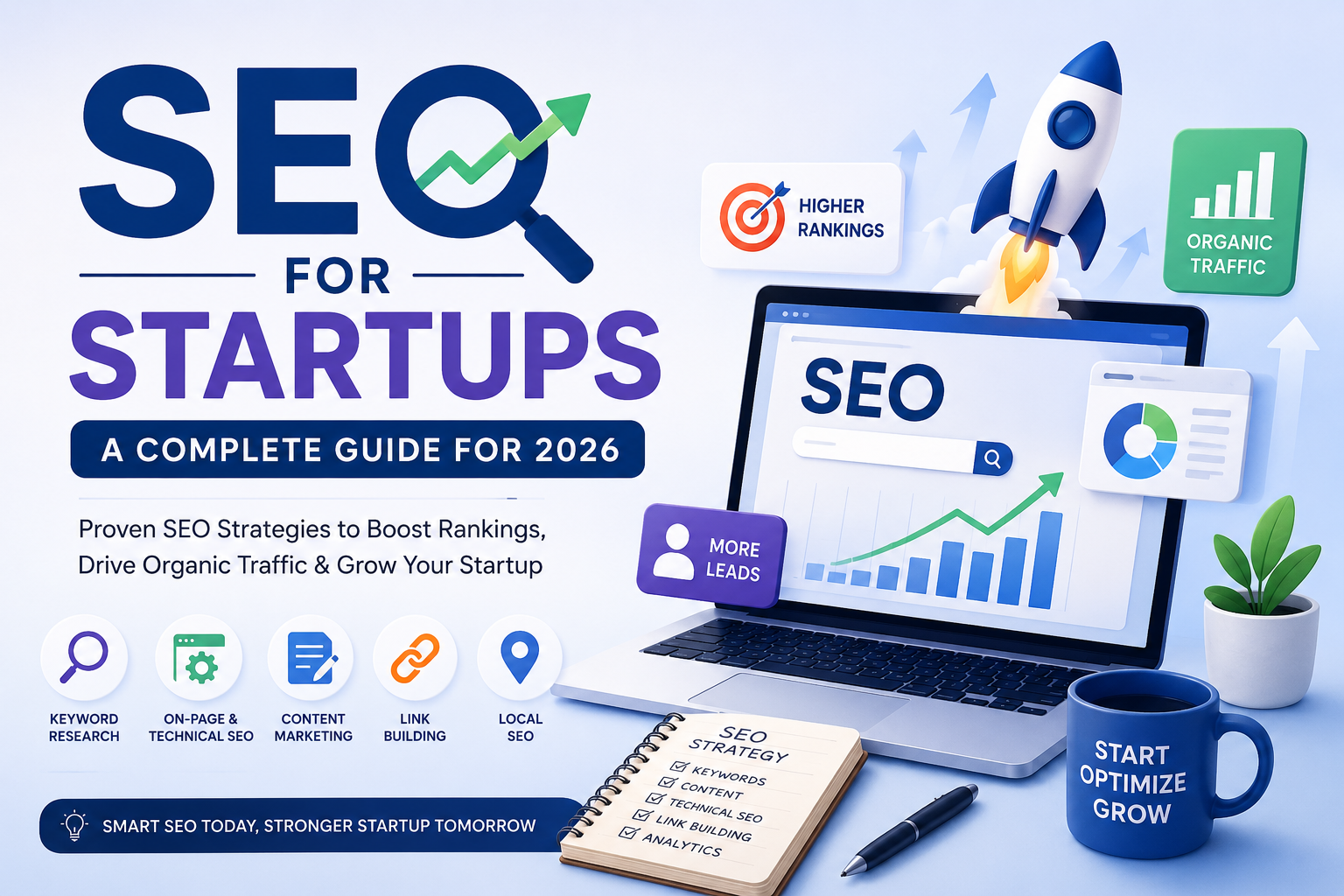
Starting a new business is exciting, but getting discovered online can be challenging. With more businesses competing for attention on Google, startups need a clear strategy to attract the right audience and build long-term visibility.
SEO for Startups helps new businesses improve their search visibility, attract organic traffic, build credibility, and generate potential customers without depending entirely on paid advertising. When implemented correctly, SEO can become a sustainable growth channel for startups.
This guide explains the essential SEO strategies for startups in 2026, from keyword research and on-page optimization to technical SEO, local search, content marketing, and performance tracking.
Table of Contents
Why SEO Matters for Startups
Startups usually operate with limited budgets, which makes cost-effective customer acquisition especially important. Paid advertising can deliver immediate visibility, but organic search can continue generating traffic after the initial optimization and content work is completed.
SEO for Startups focuses on understanding what potential customers search for and creating useful pages that address those needs.
For example, a new software company might target searches related to its software category, while a local service business could focus on searches containing its city or service area.
Google recommends creating helpful, reliable, people-first content rather than content designed primarily to manipulate rankings.
Keyword Research for Startups
Keyword research should be the foundation of your SEO strategy. Instead of targeting every popular keyword, startups should identify search terms that are relevant to their products, services, audience, and business goals.
Start with:
-
- Product and service-related keywords
- Long-tail keywords
- Problem-based searches
- Location-based keywords
- Informational queries
- Commercial-intent keywords
- Competitor-related search opportunities
For example, instead of targeting a broad term such as “digital marketing,” a startup may target “digital marketing services for small businesses” or a specific service and location.
A good SEO strategy for startups should balance search volume, competition, relevance, and user intent. Long-tail keywords can be particularly useful for newer websites because they often provide more specific search intent.
On-Page SEO for Startup Websites
Once you identify relevant keywords, optimize the important elements of your website.
Optimize Title Tags and Meta Descriptions
Every important page should have a clear, descriptive title that tells users and search engines what the page is about. Meta descriptions should encourage users to click while accurately representing the content.
Create Clear Heading Structures
Use one descriptive H1 followed by logical H2 and H3 headings. This makes longer content easier to understand and helps search engines interpret the page structure.
Optimize URLs
Keep URLs short, descriptive, and relevant to the page topic. Avoid unnecessary numbers, symbols, or complicated URL structures.
Improve Internal Linking
Internal links help users discover related content and help search engines understand the relationship between different pages.
For example, startups looking for broader growth ideas can explore our guide on Digital Marketing Strategies for Startups.
Content Strategy for Startup SEO
Content marketing and SEO work closely together. A startup should not create blog posts simply to increase the number of pages on its website.
Instead, create content that answers genuine customer questions and supports the products or services you offer.
Useful content formats include:
-
- How-to guides
- Industry guides
- Comparison articles
- Frequently asked questions
- Case studies
- Product education
- Local business guides
- Troubleshooting content
This approach supports SEO for Startups by creating multiple opportunities to appear for relevant informational and commercial searches.
Google’s SEO guidance also emphasizes understanding the terms users search for and creating content that provides a useful experience.
Technical SEO for Startups
Great content cannot perform effectively if search engines struggle to access or understand your website.
Important technical SEO areas include:
Website Speed
Improve loading performance by optimizing images, reducing unnecessary scripts, using efficient caching, and maintaining good hosting performance.
Mobile Optimization
Your website should work properly across smartphones, tablets, and desktops. A poor mobile experience can negatively affect how users interact with your website.
Crawlability and Indexing
Make sure important pages can be crawled and indexed. Check robots.txt, XML sitemaps, canonical tags, redirects, and indexing status regularly.
Website Security
Use HTTPS across your website and keep your CMS, themes, and plugins updated.
These fundamentals form an important part of startup SEO, particularly for websites that are still building their technical foundation.
Local SEO for Startups
For startups serving customers in a specific city or region, local search can provide valuable opportunities.
A startup should optimize its Google Business Profile, maintain accurate business information, collect genuine customer reviews, and create location-relevant website content.
For example, a business operating in Kochi could target relevant searches around its services and Kochi rather than competing immediately for nationwide keywords.
Google states that local results are primarily influenced by relevance, distance, and prominence, while complete and accurate Business Profile information can help businesses appear for relevant local searches.
This makes local SEO for startups particularly valuable for service-based businesses targeting customers in a specific geographical area.
Link Building and Authority
Building website authority is another important part of SEO. However, startups should focus on earning relevant, trustworthy links instead of purchasing spammy backlinks.
Good opportunities include:
-
- Industry publications
- Business directories with genuine editorial value
- Startup communities
- Partner websites
- Digital PR
- Expert contributions
- Original research and statistics
- Valuable resources that others naturally want to reference
Quality is more important than simply increasing the number of backlinks.
SEO Tools Startups Should Use
Startups can use several tools to monitor and improve their organic performance.
Google Search Console is particularly useful for understanding search queries, clicks, impressions, CTR, and average position.
Other useful tools include:
-
- Google Analytics
- Google Keyword Planner
- Semrush
- Ahrefs
- PageSpeed Insights
- Screaming Frog
- Google Business Profile
Regularly reviewing search performance helps identify which pages are generating visibility and which areas need improvement.
SEO for Startups in 2026: What Should You Focus On?
Search is becoming more competitive, and startups need to focus on quality rather than simply publishing large amounts of content.
The most effective SEO for Startups approach in 2026 should include:
-
- People-first content
- Strong topical coverage
- Search-intent-focused keyword research
- Technical SEO
- Local SEO where relevant
- Internal linking
- High-quality link earning
- Strong user experience
- Regular performance analysis
- Content updates based on real search data
Startups should also create content that demonstrates genuine expertise and provides information beyond what is already available everywhere online.
How to Measure SEO Success
SEO should be measured using meaningful business and search metrics rather than rankings alone.
Monitor:
-
- Organic clicks
- Impressions
- CTR
- Average position
- Organic conversions
- Leads
- Revenue generated from organic traffic
- Top-performing landing pages
- Search queries
- New keyword opportunities
Google Search Console allows businesses to analyze these search performance metrics and identify opportunities for improvement.
Get Professional SEO Support for Your Startup
Building organic visibility takes consistent effort across content, technical optimization, keyword research, internal linking, and authority building.
If your startup needs a structured SEO strategy, professional SEO for Startups can help create a roadmap based on your industry, target audience, competitors, and business goals.
You can explore SEO Services in Kochi from Upgraderz for professional SEO support.
SEO is not just about achieving higher rankings. For startups, it is about becoming visible when potential customers are actively searching for solutions.
A well-planned SEO strategy can help startups build organic visibility, establish authority, attract qualified traffic, and create sustainable growth. By combining keyword research, useful content, technical optimization, local search, internal linking, and ethical authority building, startups can create a stronger digital foundation for long-term success.
The key is consistency. Start with the fundamentals, measure the results, learn from search data, and continuously improve your website based on what your audience actually needs.

Rinu Ann George
Rinu Ann George is an SEO Analyst at Upgraderz, specializing in search engine optimization, content strategy, and digital visibility.