
Website or Social Media for Business: Why You Need Both

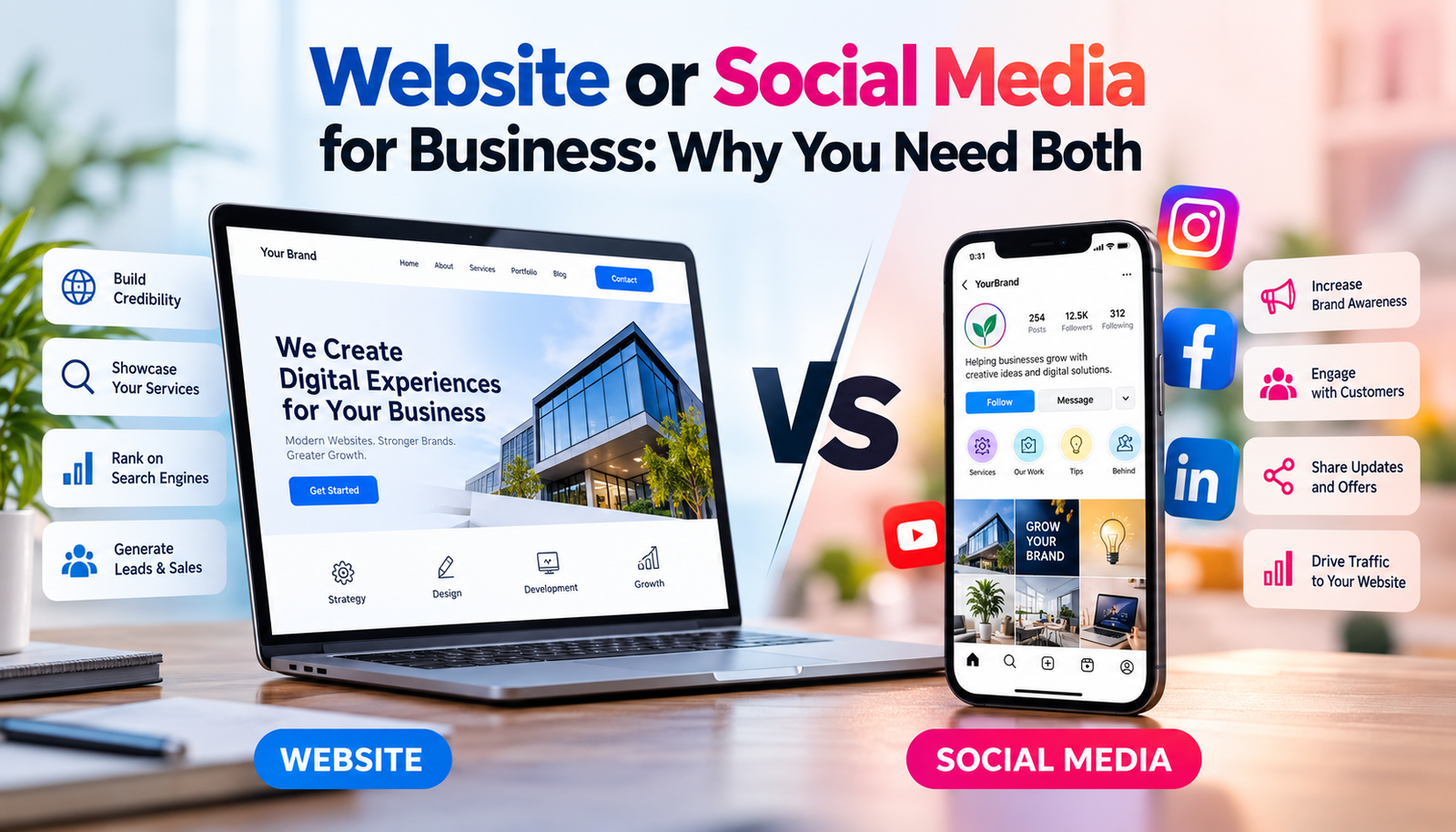
Building a strong online presence is no longer optional for businesses. Customers search online before choosing a company, comparing services, making purchases, or contacting a brand. This often raises an important question: Website or Social Media for Business — which one should you prioritize?
The best answer is not to choose one over the other. A professional website and active social media channels serve different purposes, and when they work together, they can improve brand visibility, credibility, customer engagement, lead generation, and long-term business growth.
According to DataReportal’s Digital 2026 Mid-Year Global Update, internet use and social media participation remain enormous worldwide, highlighting why businesses need to build a presence across multiple digital touchpoints.
Table of Contents
Difference Between Website and Social Media
Understanding the difference between website and social media is essential before creating your digital marketing strategy.
A website is a digital property controlled by your business. You decide its design, content, pages, calls to action, products, services, and customer journey. A professionally developed website can present detailed information about your company while helping potential customers find you through search engines.
Social media, on the other hand, operates on third-party platforms such as Facebook, Instagram, LinkedIn, and YouTube. It is primarily designed for communication, content distribution, audience interaction, community building, and brand awareness.
When considering Website or Social Media for Business, think of your website as your digital headquarters and social media as the channels that help people discover, interact with, and return to your brand.
Why Your Business Needs a Website
A professional website gives your business credibility and creates a central destination where customers can learn more about you.
With effective web designing services, businesses can create fast, responsive, mobile-friendly websites that communicate their brand identity and help turn visitors into enquiries or customers. Upgraderz notes that professional web design can strengthen credibility while creating a scalable online presence.
A website also offers an important advantage: search engine visibility. Through SEO, businesses can optimize service pages, landing pages, blogs, images, and other content around keywords their potential customers search for.
Google recommends creating helpful, reliable, people-first content that gives visitors substantial information and a satisfying experience rather than creating content primarily to manipulate search rankings.
So, when businesses ask Website or Social Media for Business, a website becomes particularly important for long-term visibility, credibility, organic traffic, and conversions.
Why Social Media Is Important for Business
Social media allows businesses to communicate directly with customers and keep their brands visible in everyday online conversations.
Platforms such as Instagram, Facebook, LinkedIn, and YouTube can help businesses share reels, videos, customer stories, product updates, educational content, offers, and company news.
Social media is particularly useful for:
-
- Increasing brand awareness
- Building customer relationships
- Sharing engaging visual content
- Generating enquiries and leads
- Promoting products and services
- Driving visitors to your website
- Building a community around your brand
The scale of the opportunity is significant. DataReportal reported 5.79 billion social media user identities worldwide at the start of April 2026, although it cautions that these identities do not necessarily represent unique individuals.
This is why the Website or Social Media for Business debate should not end with choosing social media alone. Social platforms can provide reach and engagement, while your website gives interested users a dedicated place to learn more and take action.
Website vs Social Media: Key Differences
The biggest difference is ownership and purpose.
Your website gives you greater control over your online presence. You control the design, navigation, content, SEO strategy, landing pages, and conversion journey.
Social media gives you access to established audiences and powerful engagement tools, but your visibility can depend on each platform’s algorithms, policies, features, and audience behaviour.
Another major difference is content lifespan. Social posts can quickly move down a user’s feed, whereas a well-optimized website page or evergreen blog post can continue attracting relevant visitors through search over a longer period.
Therefore, the right approach to Website or Social Media for Business depends on understanding that each channel performs a different job.
How Websites and Social Media Work Together
The strongest digital strategy connects both channels instead of treating them separately.
For example, a business can publish a useful blog on its website and promote it through Instagram, Facebook, or LinkedIn. A social media reel can attract attention and direct interested viewers to a service page. Meanwhile, website visitors can be encouraged to follow the company’s social accounts for updates.
This creates a connected customer journey:
Social Media → Awareness → Website Visit → Trust → Enquiry → Conversion
A complete digital marketing strategy can bring together SEO, social media marketing, web design, lead generation, content creation, Google Business Profile optimization, and paid advertising rather than depending on a single channel.
This integrated approach is the strongest answer to Website or Social Media for Business because one channel can support the weaknesses and strengthen the advantages of the other.
SEO and Social Media: A Powerful Combination
SEO and social media have different roles, but they can support the same business goals.
SEO focuses on improving visibility when customers actively search for information, products, or services. Social media helps businesses reach audiences, distribute content, create conversations, and build familiarity.
Businesses can publish SEO-friendly blogs on their websites and then distribute those articles through social media. Social content can generate awareness, while optimized website content can capture search demand.
For businesses investing in online marketing, combining website development, SEO, social media marketing, content marketing, local SEO, lead generation, and digital advertising can create a much stronger overall digital presence.
For additional SEO guidance, businesses can refer to Google Search Central, while digital behaviour and social media trends can be explored through DataReportal’s Digital 2026 research. These are authoritative informational resources rather than competing digital-marketing agencies.
Which Is Better for Small Businesses?
For small businesses with limited resources, starting with only one platform may seem easier. However, relying entirely on social media can leave the business without a strong independent digital destination, while having only a website can limit opportunities for regular audience engagement.
A practical small business digital marketing strategy is to establish a professional website and then choose the social platforms most relevant to the target audience.
This means the question Website or Social Media for Business should not simply be “Which is better?” Instead, businesses should ask, “How can we use both effectively?”
Customers now interact with businesses across multiple digital channels. They may discover a brand through Instagram, search for it on Google, visit its website, read reviews, compare services, and then make an enquiry.
A website provides credibility, ownership, search visibility, detailed information, and conversion opportunities. Social media provides reach, engagement, communication, brand awareness, and content distribution.
Ultimately, Website or Social Media for Business is not an either-or decision. Businesses that connect a professional website with strategic social media marketing can build a stronger online presence, reach customers at different stages of their journey, and create more opportunities for sustainable growth.

Rinu Ann George
Rinu Ann George is an SEO Analyst at Upgraderz, specializing in search engine optimization, content strategy, and digital visibility.