
Frontend vs Backend vs Full Stack: Career Comparison 2026

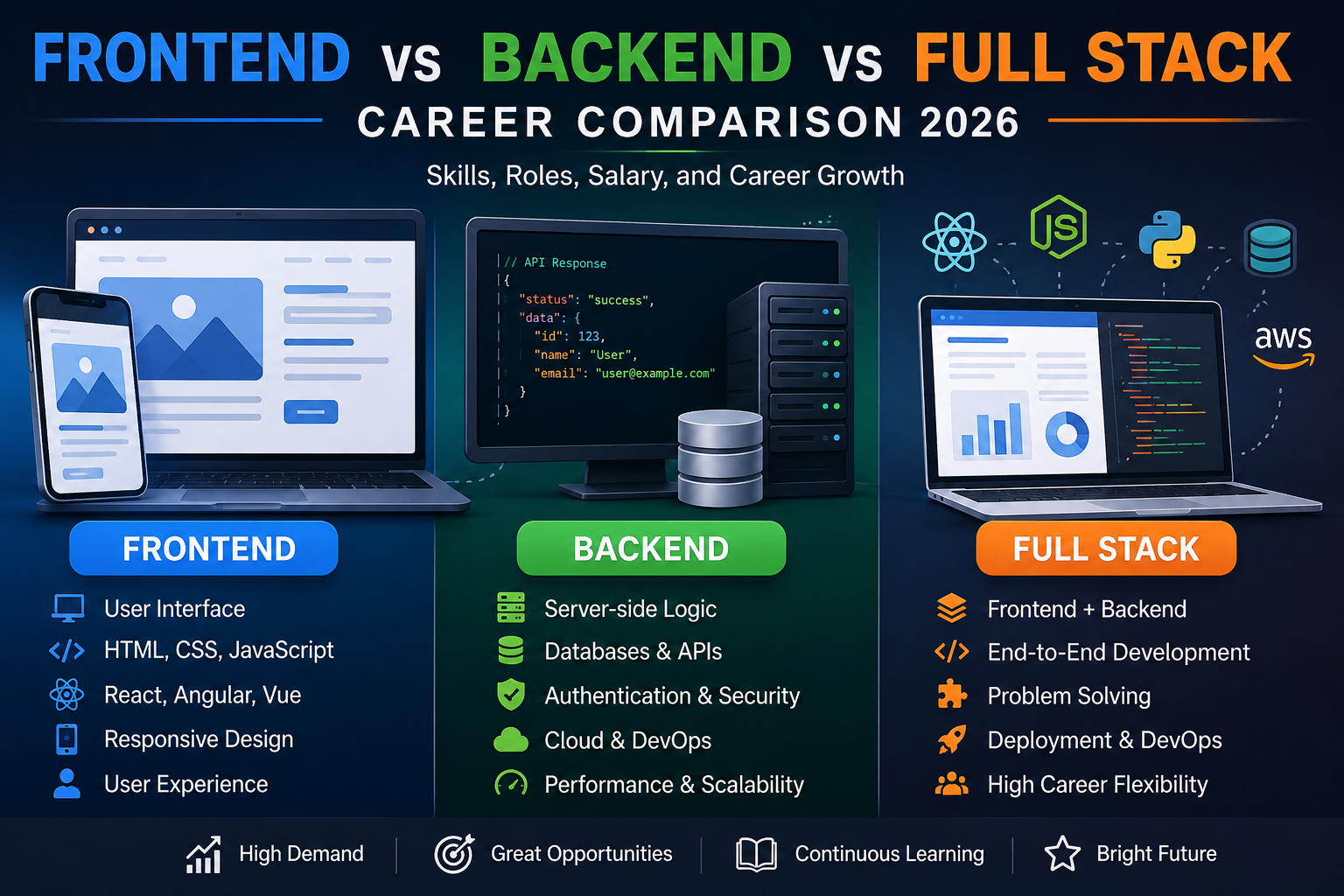
Choosing the right software development career can be challenging, especially when you are deciding between frontend development, backend development, and full stack development. Each path has different responsibilities, technologies, learning requirements, and career opportunities. This Frontend vs Backend vs Full Stack comparison will help beginners, students, and professionals understand which career path may be the best fit in 2026.
The technology industry continues to evolve rapidly. Developers are expected to understand modern frameworks, cloud platforms, APIs, databases, security, and increasingly AI-assisted development. Stack Overflow’s 2025 Developer Survey reported more than 49,000 responses from 177 countries, while 84% of respondents said they were using or planning to use AI tools in their development process.
Table of Contents
What Is Frontend Development
Frontend development focuses on everything users see and interact with on a website or web application. Frontend developers create layouts, navigation, forms, buttons, animations, dashboards, and interactive components.
The core frontend technologies include:
-
- HTML for page structure
- CSS for styling and responsive layouts
- JavaScript for interactivity
- React, Angular, or Vue for modern application development
- Git and GitHub for version control
- Web performance and accessibility techniques
According to MDN, frontend developers use HTML, CSS, and JavaScript to create the visual and interactive parts of websites.
A frontend developer should have a strong understanding of user experience, responsive web design, browser compatibility, accessibility, and performance optimization. This makes frontend development particularly suitable for people who enjoy visual problem-solving and creating user-facing experiences.
What Is Backend Development
Backend development deals with the server-side systems that power websites and applications. While users interact with the frontend, the backend handles business logic, authentication, databases, APIs, server operations, and data processing.
Common backend technologies include:
-
- Node.js
- Python
- Java
- PHP
- C#
- Ruby
- SQL and NoSQL databases
- REST and GraphQL APIs
- Cloud and server technologies
Backend developers need to understand database design, API development, authentication, security, scalability, server performance, and application architecture.
Python is particularly relevant in today’s development landscape. Stack Overflow’s 2025 survey reported a significant increase in Python adoption, connecting its growth with AI, data science, and backend development.
This makes backend development a strong option for people who enjoy logic, data, system architecture, and solving complex technical problems.
What Is Full Stack Development
Full stack development combines frontend and backend development. A full stack developer can work across the user interface, server-side application, databases, APIs, and deployment environment.
A typical full stack technology stack might include:
-
- HTML, CSS, and JavaScript
- React or another frontend framework
- Node.js, Python, Java, or PHP
- MySQL, PostgreSQL, MongoDB, or other databases
- REST APIs
- Git and GitHub
- Cloud platforms
- Docker and deployment tools
MDN describes a full stack developer as someone who handles both frontend and backend development tasks.
The biggest advantage of full stack development is versatility. Developers can understand how different parts of an application work together, which can be valuable in startups, product teams, agencies, and smaller development teams.
Frontend vs Backend vs Full Stack: Key Differences
When comparing Frontend vs Backend vs Full Stack, the main difference is the area of responsibility.
| Factor | Frontend Developer | Backend Developer | Full Stack Developer |
|---|---|---|---|
| Main focus | User interface | Server and data | Frontend + backend |
| Primary skills | HTML, CSS, JavaScript | APIs, databases, servers | Frontend + backend |
| User interaction | High | Low | High + technical |
| Database knowledge | Basic to moderate | Advanced | Moderate to advanced |
| Learning scope | Narrower | Specialized | Broadest |
| Career flexibility | High | High | Very high |
| Project responsibility | UI and client side | Server and business logic | End-to-end application |
For beginners, Frontend vs Backend vs Full Stack should not be treated as a competition where one role is automatically better. The right choice depends on your interests, strengths, preferred work style, and long-term career goals.
Skills You Need in 2026
Modern developers need more than programming language knowledge. Employers increasingly value problem-solving, collaboration, version control, testing, cloud knowledge, security awareness, and the ability to work with modern development tools.
AI-assisted development is also becoming part of the workflow. Stack Overflow’s 2025 survey found that 84% of respondents were using or planning to use AI tools, although developers also reported concerns about accuracy and trust.
Therefore, learning how to verify AI-generated code is just as important as learning how to use AI coding tools.
Other valuable skills include:
-
- Git and GitHub
- REST APIs
- Cloud computing
- Docker
- Testing and debugging
- Cybersecurity fundamentals
- Database management
- Responsive design
- Technical communication
- AI-assisted development
Frontend vs Backend vs Full Stack: Which Has the Easier Learning Curve
Frontend development can be easier to start because beginners can immediately see the results of their HTML, CSS, and JavaScript code. However, advanced frontend engineering involves complex topics such as state management, performance, accessibility, testing, and application architecture.
Backend development may have a steeper initial learning curve because developers need to understand servers, databases, APIs, authentication, security, and business logic.
Full stack development has the broadest learning scope because it requires knowledge of both frontend and backend technologies. Frontend vs Backend vs Full Stack therefore also becomes a question of specialization versus versatility.
Beginners should avoid trying to learn every technology at once. A better approach is to build a strong foundation and gradually expand into related technologies.
Career Opportunities and Growth
All three paths can lead to strong software development careers. Frontend developers can progress toward senior frontend developer, UI engineer, frontend architect, or product engineer roles.
Backend developers can move into senior backend development, API engineering, cloud engineering, platform engineering, or software architecture.
Full stack developers can progress toward senior full stack development, technical leadership, product engineering, or software architecture.
The 2025 Stack Overflow Developer Survey specifically tracks full-stack, back-end, and front-end developer roles, showing that all three remain established categories within the professional developer ecosystem.
Salary: Frontend vs Backend vs Full Stack
Salary should not be the only factor when choosing a development career. Compensation varies considerably according to location, experience, company, technology stack, specialization, and seniority.
Instead of assuming that one role always pays more, focus on developing skills that employers value. Strong system design, cloud knowledge, security, scalable architecture, modern frontend engineering, and practical project experience can all contribute to career growth.
For students and professionals in India, building a portfolio with real projects can be particularly valuable. A developer who can demonstrate practical problem-solving may stand out more than someone who simply lists many programming languages on a resume.
How to Choose the Right Career Path
When evaluating Frontend vs Backend vs Full Stack, consider your natural interests.
Choose frontend development if you enjoy:
-
- Visual design and interfaces
- User experience
- Creating interactive websites
- Browser technologies
- Seeing immediate visual results
Choose backend development if you enjoy:
-
- Logic and problem-solving
- Databases
- APIs
- System architecture
- Security and scalability
Choose full stack development if you enjoy:
-
- Working across different technologies
- Building complete applications
- Understanding both users and systems
- Flexible project responsibilities
- Learning continuously
Why Digital Skills Matter Beyond Development
Developers also benefit from understanding how websites attract and serve users. Knowledge of SEO, analytics, content strategy, and digital marketing can help developers create technically sound websites that are easier to discover and use.
For businesses looking to combine technology with online growth, professional digital marketing services in Kochi can complement web development by improving search visibility, traffic acquisition, and online performance.
Developers can also explore useful plugins and digital tools that support website functionality and business workflows.
Frontend vs Backend vs Full Stack: Final Verdict
There is no universal winner in Frontend vs Backend vs Full Stack. Frontend development is ideal for people who enjoy interfaces and user experiences. Backend development suits people who prefer logic, databases, APIs, and system architecture. Full stack development is a strong choice for people who want broader technical responsibilities and end-to-end development skills.
The best strategy in 2026 is to choose one area as your foundation and become genuinely strong at it before expanding. Learn modern tools, build real-world projects, understand fundamentals, use AI responsibly, and continuously improve your technical skills.
Ultimately, Frontend vs Backend vs Full Stack is less about choosing the “best” technology career and more about choosing the path that matches your interests, abilities, and long-term goals. With consistent learning and practical experience, all three paths can lead to rewarding careers in software development.

Rinu Ann George
Rinu Ann George is an SEO Analyst at Upgraderz, specializing in search engine optimization, content strategy, and digital visibility.