
Digital Marketing KPIs Every Business Owner Should Understand in 2026

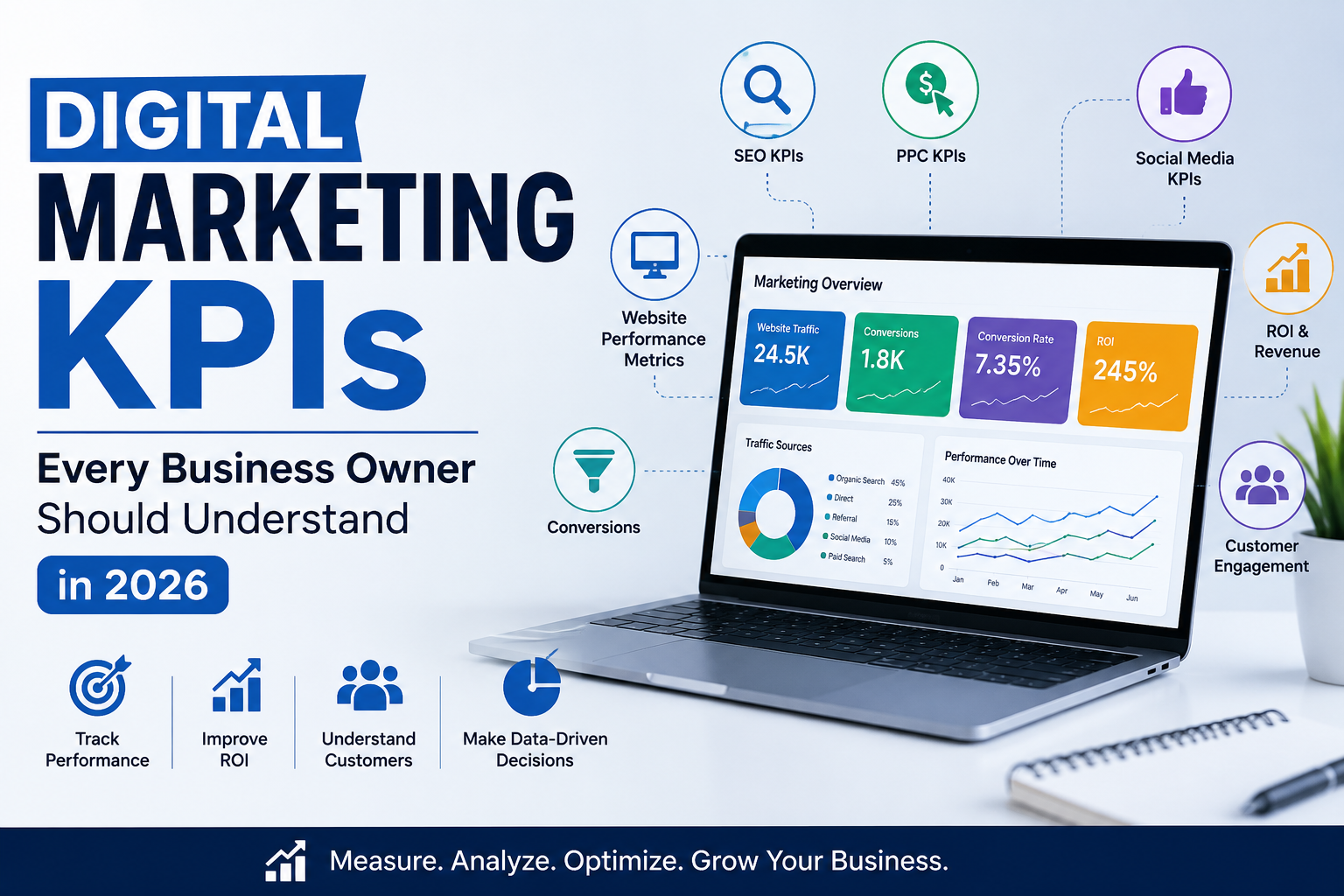
In today’s competitive online landscape, simply running digital campaigns is no longer enough. Business owners need measurable insights to understand what’s working and where improvements are needed. This is where Digital Marketing KPIs become essential.
Whether you’re investing in SEO, paid advertising, social media, or email campaigns, tracking the right metrics helps maximize your marketing budget and improve business growth. Instead of relying on assumptions, businesses can use data to make informed decisions that increase leads, sales, and customer engagement.
In this guide, we’ll explain the most important Digital Marketing KPIs every business owner should understand in 2026, why they matter, and how they contribute to long-term success.
Table of Contents
What Are Digital Marketing KPIs
Digital Marketing KPIs (Key Performance Indicators) are measurable values that indicate how effectively your marketing efforts are achieving specific business goals. They help businesses monitor campaign performance, identify opportunities for improvement, and measure return on investment.
Unlike vanity metrics such as page likes or impressions alone, meaningful KPIs directly relate to business objectives like generating leads, increasing website traffic, improving conversions, or boosting revenue.
Monitoring the right marketing KPIs ensures that every marketing activity contributes toward measurable business success. Businesses can use tools like Google Analytics 4 to track these metrics and make data-driven marketing decisions. Learn more in the Google Analytics Help Center:
Why Tracking Digital Marketing KPIs Matters in 2026
Digital marketing platforms continue evolving rapidly with AI-powered search, changing privacy regulations, and smarter customer journeys. Businesses that regularly monitor Digital Marketing KPIs gain several advantages:
-
- Better allocation of marketing budgets
- Improved customer targeting
- Higher conversion rates
- Stronger campaign optimization
- Data-driven decision making
- Increased return on investment (ROI)
Instead of guessing which campaign works best, business owners can confidently scale strategies backed by performance data.
Essential Digital Marketing KPIs Every Business Should Track
Website Traffic
Website traffic measures the number of visitors coming to your website through various channels such as:
-
- Organic Search
- Direct Traffic
- Referral Traffic
- Social Media
- Paid Search
- Email Marketing
Tracking website traffic helps identify which channels generate the highest quality visitors and where additional investment may be needed.
Website traffic remains one of the most important website performance metrics because every online conversion begins with attracting visitors.
Organic Search Performance
Organic traffic reflects visitors arriving through search engines without paid advertisements.
Key SEO KPIs include:
-
- Organic sessions
- Keyword rankings
- Click-Through Rate (CTR)
- Bounce Rate
- Average Session Duration
- Indexed Pages
Monitoring these SEO KPIs helps businesses evaluate how well their content performs in search engines and whether optimization efforts are delivering results.
Conversion Rate
One of the most valuable Digital Marketing KPIs is conversion rate.
It measures the percentage of visitors who complete a desired action, such as:
-
- Filling out a contact form
- Making a purchase
- Booking an appointment
- Downloading a brochure
- Requesting a quotation
Formula:
Conversion Rate = (Conversions ÷ Total Visitors) × 100
Improving conversion rates often delivers better ROI than simply increasing website traffic.
Cost Per Lead (CPL)
Cost Per Lead measures how much money is spent to generate one qualified lead.
Businesses using Google Ads, Facebook Ads, or LinkedIn campaigns should monitor CPL carefully.
Lower CPL combined with higher-quality leads usually indicates better campaign performance and more efficient spending.
Customer Acquisition Cost (CAC)
Customer Acquisition Cost shows how much your business spends to acquire one paying customer.
Formula:
CAC = Total Marketing Cost ÷ Number of New Customers
Reducing CAC while maintaining lead quality improves overall profitability.
Return on Investment (ROI)
Every business owner wants to know whether marketing efforts generate profits.
ROI remains one of the most critical Digital Marketing KPIs because it measures overall financial success.
Formula:
ROI = (Revenue − Marketing Cost) ÷ Marketing Cost × 100
Higher ROI means marketing investments are producing positive business outcomes.
Email Marketing Performance
Email campaigns continue delivering excellent returns when properly optimized.
Important marketing analytics metrics include:
-
- Open Rate
- Click Rate
- Conversion Rate
- Unsubscribe Rate
- Revenue per Email
Tracking these metrics helps improve customer communication and long-term retention.
Social Media KPIs
Social media success goes beyond follower counts.
Important social media KPIs include:
-
- Engagement Rate
- Reach
- Shares
- Comments
- Profile Visits
- Website Clicks
- Leads Generated
Businesses should evaluate how social media contributes to overall business goals rather than focusing only on vanity metrics.
Paid Advertising Performance
Businesses running Google Ads or Meta Ads should closely monitor important PPC KPIs, including:
-
- Cost Per Click (CPC)
- Click-Through Rate (CTR)
- Cost Per Acquisition (CPA)
- Quality Score
- Conversion Rate
- Return on Ad Spend (ROAS)
These digital marketing metrics help determine whether paid campaigns are profitable and sustainable.
Customer Lifetime Value (CLV)
Customer Lifetime Value estimates the total revenue generated by a customer throughout their relationship with your business.
When combined with Customer Acquisition Cost, CLV helps businesses determine long-term profitability.
Growing customer lifetime value often provides greater returns than continuously acquiring new customers.
How Marketing Analytics Improve Business Decisions
Modern marketing analytics platforms such as Google Analytics 4 and Google Search Console provide real-time performance insights.
Business owners can use these tools to:
-
- Understand customer behavior
- Measure campaign effectiveness
- Identify top-performing content
- Improve website experience
- Optimize advertising campaigns
- Increase lead generation
Using analytics effectively transforms raw data into actionable business strategies.
Choosing the Right Digital Marketing Performance Metrics
Not every business should track the same metrics.
For example:
| Business Goal | Key Performance Indicators in Digital Marketing |
|---|---|
| Brand Awareness | Website Traffic, Reach, Impressions |
| Lead Generation | Conversion Rate, Cost Per Lead |
| Online Sales | Revenue, ROI, Average Order Value |
| SEO Growth | Organic Search, Keyword Rankings, CTR |
| Paid Campaigns | CPC, CPA, ROAS |
| Customer Loyalty | Repeat Purchases, CLV |
Selecting relevant key performance indicators in digital marketing ensures your reporting aligns with business objectives rather than vanity numbers.
How Professional Digital Marketing Services Can Help
Tracking dozens of metrics manually can become overwhelming. Partnering with experienced digital marketers ensures your business monitors the right Digital Marketing KPIs, interprets data accurately, and continuously improves campaign performance.
If you’re looking to increase leads, improve SEO rankings, run profitable PPC campaigns, or strengthen your online presence, explore Upgraderz’s Digital Marketing Services to build data-driven marketing strategies tailored to your business goals.
Success in digital marketing is no longer measured by guesses or assumptions. Businesses that consistently monitor Digital Marketing KPIs gain valuable insights into customer behavior, campaign performance, and overall profitability.
From SEO KPIs and website performance metrics to social media KPIs, PPC KPIs, marketing analytics, and digital marketing performance, every metric contributes to smarter decision-making.
As digital competition continues to grow in 2026, understanding and tracking the right Digital Marketing KPIs will help businesses maximize ROI, improve customer engagement, and achieve sustainable long-term growth.

Rinu Ann George
Rinu Ann George is an SEO Analyst at Upgraderz, specializing in search engine optimization, content strategy, and digital visibility.