
Website Redesign and SEO: How It Affects Google Rankings

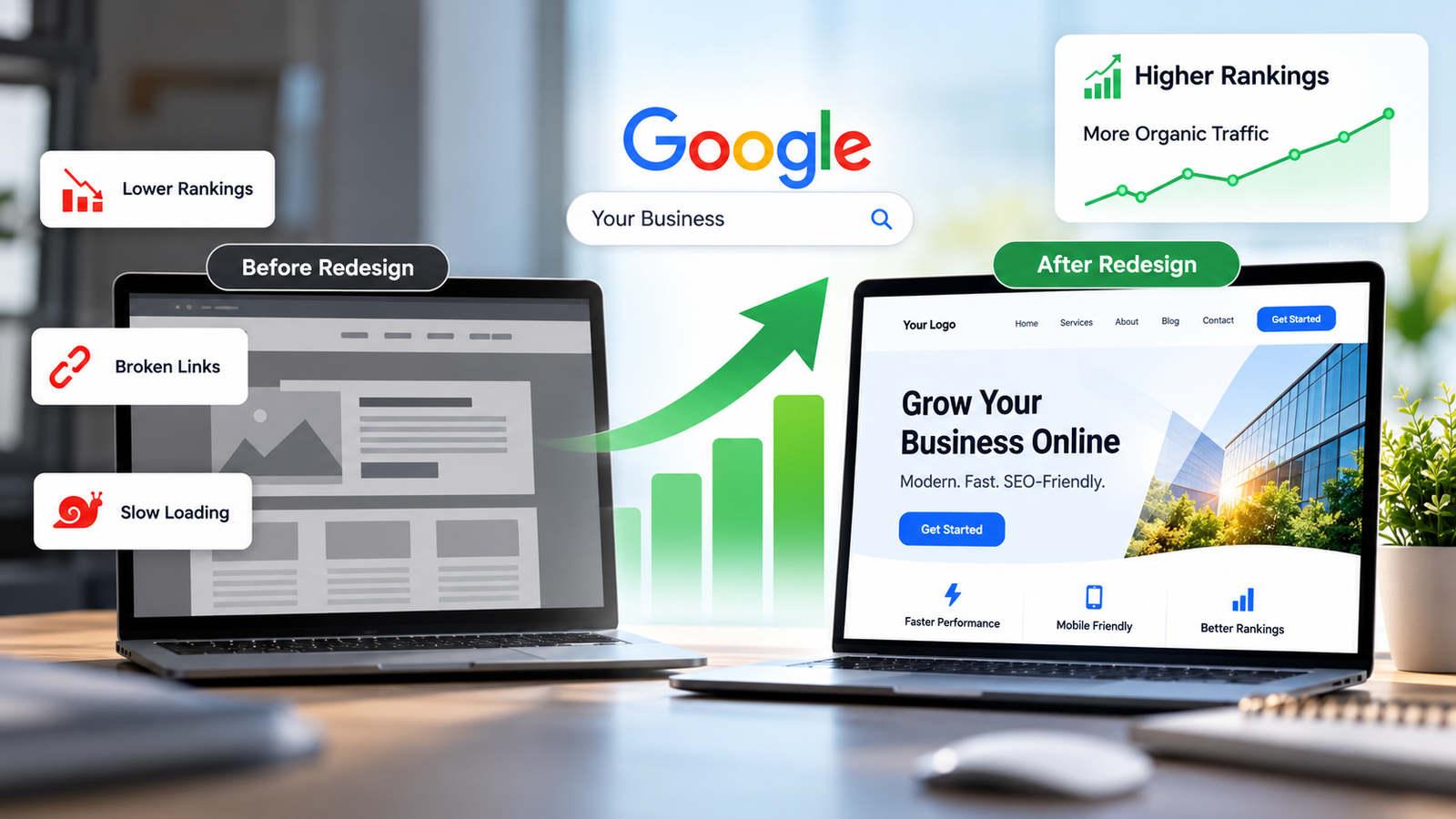
Redesigning your website can improve its appearance, user experience, speed, and overall performance. However, a website redesign can also affect your Google rankings if important SEO elements are overlooked during the process.
Many businesses invest in modern website designs without considering how changes to URLs, content, navigation, and technical structure may influence their search engine visibility. As a result, websites that previously attracted organic traffic can experience ranking fluctuations or significant traffic losses after launch.
Understanding the relationship between Website Redesign and SEO is essential for protecting existing rankings while creating a faster, more engaging, and search-friendly website.
Table of Contents
How Does a Website Redesign Affect Google Rankings?
A website redesign involves more than changing colours, fonts, images, and layouts. It may include modifications to website architecture, page URLs, content, internal links, and technical configurations.
Why Google Rankings May Change After a Redesign
Google evaluates websites using multiple signals, including content relevance, accessibility, page experience, and the ability to discover and index important pages.
When these elements change, Google may need to recrawl and reassess the affected pages.
Common SEO Problems After Website Redesign
Poorly managed redesigns can lead to:
- Loss of existing keyword rankings
- Reduced organic website traffic
- Broken links and missing pages
- Indexing and crawling problems
- Poor mobile usability
- Reduced visibility in Google search results
A successful Website Redesign and SEO strategy focuses on preserving valuable existing assets while improving the website’s technical foundation.
Why Technical SEO Matters During Website Redesign
Technical SEO ensures that search engines can efficiently crawl, understand, and index your website.
During a redesign, developers may introduce structural changes that affect search engine accessibility.
Essential Technical SEO Elements to Check
URL Structure: Maintain existing URLs wherever possible. If changes are necessary, implement appropriate permanent redirects.
XML Sitemap: Update the sitemap to include relevant, indexable pages.
Robots.txt: Ensure important sections are not accidentally blocked from search engine crawlers.
Canonical Tags: Use appropriate canonical URLs to clarify preferred page versions.
HTTPS Security: Maintain secure connections throughout the website.
How Technical SEO Protects Search Visibility
Technical SEO helps preserve important search signals, supports efficient crawling, and reduces the risk of indexing errors.
Businesses can address these requirements through professional SEO services at Upgraderz, which help identify technical issues and protect search visibility during website changes. What Happens When You Change Website URLs?
What Happens When You Change Website URLs?
Changing URLs is one of the most significant SEO considerations during a website redesign.
Why URL Changes Can Affect Rankings
For example, an existing page might use:
example.com/digital-marketing-servicesAfter redesigning, the URL might become:
example.com/services/digital-marketingWithout a proper redirect, users and search engines accessing the original URL may encounter a 404 error.
This can interrupt access to valuable content and weaken the continuity of existing search signals.
How 301 Redirects Help Preserve SEO
Implementing 301 redirects helps search engines understand that a page has permanently moved to a new location.
A complete Website Redesign and SEO plan should include a URL mapping document connecting every important old URL to its most relevant new destination.
Avoid redirecting every deleted page to the homepage. Instead, redirect pages to closely related replacements where appropriate.
How Website Content Changes Affect SEO Performance
Content plays an important role in determining which search queries your website can rank for.
During redesigning, businesses sometimes remove detailed service descriptions, shorten informative pages, or replace keyword-rich text with visual elements.
Why Removing Existing Content Can Hurt SEO
Although shortening content may improve appearance, removing useful information can reduce a page’s relevance for important searches.
Pages that previously ranked for specific keywords may lose visibility if relevant sections disappear.
How to Optimize Content During Redesign
Before changing content:
- Identify pages generating organic traffic.
- Review keywords associated with high-performing pages.
- Preserve valuable headings and informative sections.
- Improve outdated content without removing useful information.
- Maintain descriptive title tags and meta descriptions.
- Add meaningful image alternative text.
Effective Website Redesign and SEO planning combines attractive design with helpful, relevant, and properly structured content.
Website Speed, Core Web Vitals, and User Experience
Website performance can influence both user satisfaction and search visibility.
A redesign may introduce large images, animations, third-party scripts, or complex layouts that slow down loading times.
Understanding Google’s Core Web Vitals
Google’s Core Web Vitals measure important aspects of real-world user experience:
- Largest Contentful Paint (LCP): Measures loading performance. A good target is 2.5 seconds or less.
- Interaction to Next Paint (INP): Measures responsiveness. A good target is 200 milliseconds or less.
- Cumulative Layout Shift (CLS): Measures visual stability. A good target is 0.1 or less.
How to Improve Website Performance
Optimize images, reduce unnecessary scripts, enable browser caching, and choose reliable hosting.
Improving Core Web Vitals can support a better user experience, although strong scores alone do not guarantee higher rankings.
For authoritative guidance, refer to Google’s Core Web Vitals documentation.The Importance of Mobile-Friendly Website Design
The Importance of Mobile-Friendly Website Design
Google primarily uses the mobile version of website content for indexing.
Therefore, a redesigned website must provide accessible content and a consistent experience across different screen sizes.
Common Mobile SEO Issues
Common problems include unreadable text, oversized images, difficult navigation, and content that is missing from the mobile version.
Best Practices for Mobile SEO
A mobile-friendly Website Redesign and SEO approach ensures that important content, navigation links, structured data, and metadata remain accessible to Google.
Responsive design also helps visitors browse services, submit enquiries, and interact with the website comfortably.
Website Redesign SEO Checklist: Before and After Launch
A structured checklist helps businesses reduce SEO risks throughout the redesign process.
SEO Checklist Before Website Launch
- Conduct a complete technical SEO audit.
- Back up existing website content and SEO data.
- Identify high-ranking pages and valuable backlinks.
- Prepare a URL redirect mapping.
- Test website speed and mobile responsiveness.
- Verify canonical tags and indexing settings.
SEO Checklist After Website Launch
- Test all permanent redirects.
- Submit the updated XML sitemap to Google Search Console.
- Check for broken internal links and crawl errors.
- Confirm that important pages are indexable.
- Monitor organic traffic and keyword rankings.
- Compare performance against pre-redesign benchmarks.
For detailed technical recommendations, read the official Google Search Central website migration guide.
How Long Does SEO Take to Recover After a Website Redesign?
Ranking fluctuations after significant website changes can occur because Google needs time to crawl, process, and reassess updated pages.
Factors That Influence SEO Recovery Time
For websites involving URL migrations, this process may take several weeks or longer, depending on website size, crawlability, and technical implementation.
However, not every redesign causes ranking losses. Websites that preserve URLs, important content, internal linking structures, and indexing accessibility may experience fewer disruptions.
How to Monitor Rankings After Redesign
Monitoring Website Redesign and SEO performance through Google Search Console and Google Analytics helps businesses distinguish temporary fluctuations from technical problems requiring immediate attention.
Review indexing reports, organic landing pages, keyword impressions, clicks, and conversion performance regularly.
How Upgraderz Helps Protect Your SEO During Website Redesign
At Upgraderz Digital Solutions, we understand that a successful website redesign must balance visual appeal, technical performance, and search engine visibility.
Technical SEO and Website Optimization
Our approach to Website Redesign and SEO focuses on identifying technical risks, maintaining important website content, improving site structure, and supporting long-term organic visibility.
Building Websites for Long-Term Organic Growth
From technical SEO audits and keyword optimisation to internal linking and website performance improvements, a carefully planned strategy helps businesses avoid preventable ranking losses.
A website redesign should be an opportunity to strengthen your online presence rather than risk losing valuable Google rankings.
By protecting existing URLs, implementing proper redirects, preserving relevant content, improving mobile usability, and addressing technical SEO issues, businesses can create a modern website without unnecessarily sacrificing organic visibility.
Investing in professional Website Redesign and SEO planning helps ensure your redesigned website is attractive to visitors, accessible to search engines, and prepared for sustainable growth.
Planning to redesign your website? Explore Upgraderz Digital Solutions’ SEO services to build a search-friendly website that supports your business goals.

Rinu Ann George
Rinu Ann George is an SEO Analyst at Upgraderz, specializing in search engine optimization, content strategy, and digital visibility.